Beograd – Savez ekoloških organizacija Srbije (SEOS) send a letter to representatives of the European Commission in which they emphasized that the citizens of Serbia remain committed to preventing the excavation of lithium in the Jadar Valley and that the European Union, European Investment Bank and European Bank for Reconstruction and Development should not provide any support to the Jadar project.
The letter was addressed to the President of the European Commission, Ursula von der Leyen, Vice-President of the European Commission Maroš Šefčovič, President of the European Investment Bank Nadia Calvino and President of the European Bank for Reconstruction and Development (EBRD) Odile Renaud-Basso.
According to the SEOS, the letter was sent because of the „sudden rush“ by Vice-President Šefčovič to conclude a „controversial agreement on the trade of rare raw materials between the EU and Serbia“ at the end of the Commission’s mandate.
„Although it seems general, this document obviously aims to help political and business lobbies trying to revive the Jadar lithium project that hundreds of thousands of Serbian citizens have resolutely rejected through petitions and street demonstrations, and then the Serbian government reluctantly abandoned it in January 2022,“ the statement said.
The question arises whether Von der Leyen can confirm that the European future of Serbia will not be conditioned by the mining project that Serbian citizens rejected.
„Rest assured that we remain fully committed to preventing the Jadar lithium project from ever being implemented. If necessary, and as we did in 2022, mass demonstrations and civil disobedience will be organized,“ SEOS emphasized.
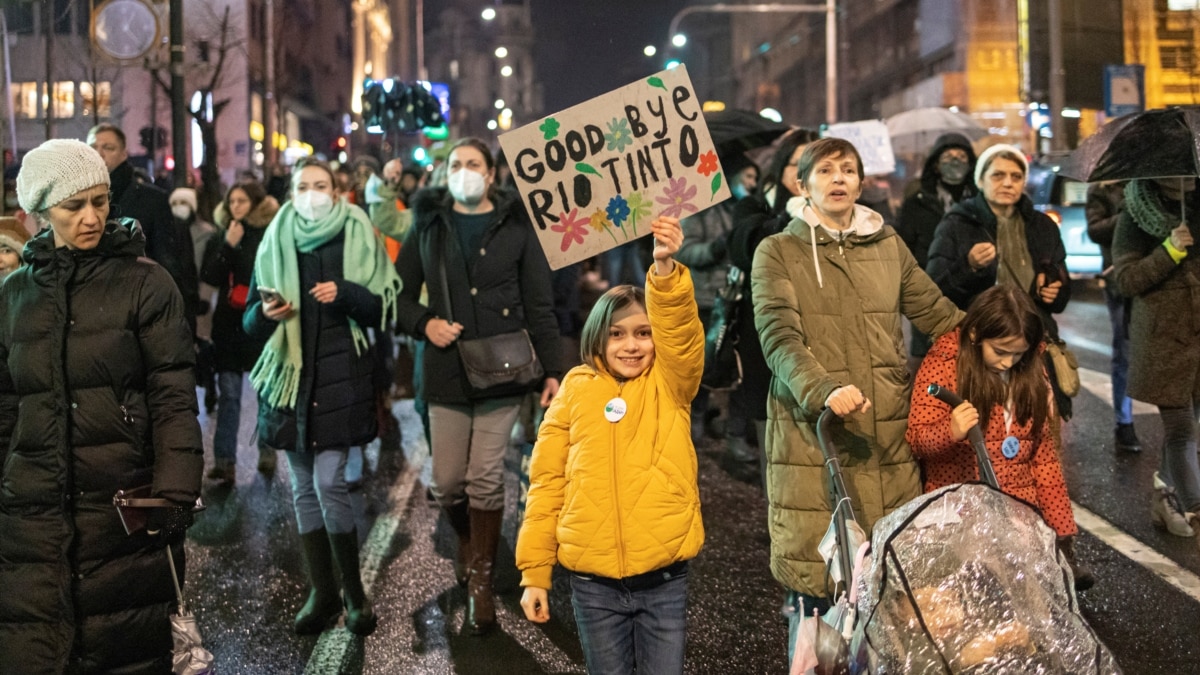
Citizens protested massively against lithium mining and blocked roads in Serbia at the end of 2021 and the beginning of 2022. The reason for the protests was the intention of the British-Australian mining giant to open a lithium mine in the Jadar river area, worth 2.4 billion dollars.
Under public pressure, the Serbian government decided to annul all decisions related to the „Rio Tinto“ project.
However, environmental activists continued sporadic protests and actions, believing that the project had not been terminated. They are calling for the permanent ban on lithium mining in Serbia by law. Rio Tinto continued its activities and research in Serbia, and senior officials in Serbia have once again raised the issue of lithium mining.
Brnabić: Lithium cannot be extracted before 2028
The President of the Serbian Parliament, Ana Brnabić, stated today that it is not about lithium, but whether Serbia will be a dependent country and import everything.
Brnabić told Hepi television that opponents of lithium had slowed everything down, that Europe would mine lithium before Serbia, that there would be lithium projects in Germany, Czech Republic, and Finland by 2026, and that even if Serbia continued tomorrow, it would not be able to start mining lithium before 2028.
„We will not export lithium, but we will use it here, to have the entire value chain here, up to battery production and battery storage,“ Brnabić said, adding that Serbia is in a position to be a European leader in the next 100 years.
She criticized public figures speaking against lithium mining in Serbia and that the point of it all is „destabilization of Serbia.“
Đedović: Jadarite – a path to self-sustainability
Minister of Mining and Energy, Dubravka Đedović Handanović stated, participating in a conference dedicated to nature conservation, „Serbia goes green,“ that the jadarite that Serbia possesses is something that Serbia can use to pursue self-sustainability, a path that the whole of Europe is taking, emphasizing the importance of Serbia utilizing its potential in terms of mineral resources.
„Serbia has a unique opportunity not only to be an exporter of finished products, not just batteries, but also the production of electric vehicles. We have the opportunity to use mineral resources. If the whole of Europe is moving towards greater self-sustainability, I see no reason why Serbia should not do so if it has minerals like jadarite,“ she said.
Đedović Handanović pointed out that a large, transparent public discussion is expected regarding this project with an emphasis on environmental protection and finding the best solutions.
She emphasized that Serbia’s priority is to have an energy system that is safe, stable, and sustainable, with as many renewable energy sources as possible and with minimal environmental impact, and that balancing is important, that in the green transition, we preserve both the safety and security of the energy system.
„The malfunction that hit the energy system in countries in the region last week is a sign that we must work together because we are connected both regionally and with the EU system,“ said Đedović Handanović.
Žiofre: EU imperative „reconciliation with nature“
The Head of the EU Delegation in Serbia, Emanuel Žiofre, said that the imperative of our generation is „reconciliation with the planet and nature.“
„We have too much pollution, exploitation of wealth, destruction of forests, and these are all signs that our connection with the planet is broken,“ Žiofre said.
He emphasized that the EU is fully committed to this generational undertaking and ambitious goals have been set for both member states and others.
„We want to become a neutral continent by 2050, a similar level we want worldwide. Serbia is part of this. We need to take some activities with the authorities in Serbia and civil society, and we can be comforted by some public opinion research indicating that 94 percent of Serbian citizens support the transition,“ added Žiofre.
He stressed that the EU’s desire is for Serbia to become a partner in this challenge, and that we care about the future of the citizens of Serbia.
Sources: Agency FoNet.
Građani Srbije protiv kopanja litijuma

Podeli vest